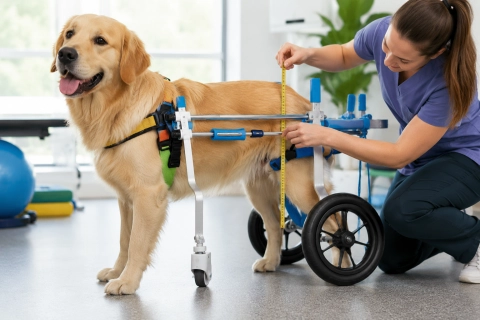
How to Size a Large Dog Wheelchair When Weight and Measurements Conflict: A Step GuideA large dog with weak hind legs puts the sizing question in one specific place: weight tells you whether the frame is strong enough to carry the dog, and nothing about whether the side rails will clear the hips or the paws will sit off the ground. Those two things come from back height and hip width. A dog wheelchair for large dogs sized on weight alone can be strong and still wrong. It rubs the hips, drags the paws, and leans through every turn. The gap closes when the frame's adjustment points, not its weight rating, decide the size. When Weight and Body Measurements Disagree, the Adjustable Frame Decides the Fit Body weight and body dimensions answer two different questions. Weight confirms the frame and wheels can hold the dog's mass without flexing or tipping. Back height, hip width, and torso length decide where the rails sit, how far the paws hang, and how much room the hips get. When a chart sorts by weight and the dog's body lands in a different tier, the dimensions win. Guessing off weight alone produces a frame that is strong in the wrong shape. A too-narrow hip width presses the rear bars directly against the hips and thighs. A too-wide one lets the frame rock side to side on every turn. A frame that is too long sits behind the dog and turns steering into a fight, with pressure running up the spine. A frame that is too short crowds the rib cage and pulls the rear harness too far forward. Inflated measurements loosen the internal harness, which rubs the skin and lets the cart drift as the dog moves. The narrow-width failure is the one people feel first, and the mechanics are straightforward. The rear width bars carry the dog's weight across whatever surface they touch. Make the bar narrower and the same load concentrates onto a smaller patch of skin and muscle. Higher pressure per square inch means rubbing, and a dog that feels the rub shifts its weight to one side to get off it. That sideways shift is exactly what makes a cart wobble in a turn. The fix is not more padding. It is a frame whose width can actually open to match the hips. Adjustable dog wheelchair frames built for large dogs handle this by making width, height, and length independent adjustment points instead of one fixed shell. Sliding channels or push-button tracks let the same frame open or close a few inches where the dog's body actually varies. That range is what lets one frame absorb the conflict between weight and measurements, and the reason to read it before committing to a size. Frame Dimension Typical Adjustment Range What It Resolves for a Large Dog Height 2-3 inches Sets ground clearance so weak paws do not drag Width 2-3 inches Opens for hip and thigh width so the bars do not rub Length More than 2-3 inches Positions the harness and saddle along the torso Back Height and Hip Width Are the Two Measurements That Control the Frame Which limbs are affected picks the frame style before any number is taken. A dog with weak or paralyzed hind legs but working front legs needs a back leg wheelchair: the front legs steer and carry, while the frame takes the back half. A dog that cannot bear weight on all four legs needs full support dog wheelchair instead. That choice comes first, and it changes which measurements matter. For the rear-support frames that most large dogs with hind-limb weakness use, two numbers carry the fit: back height and hip width. Back height sets the wheel size and strut length, which controls ground clearance. Hip width sets the rear frame width, which controls rubbing and side-to-side wobble. Torso length positions the harness and saddle, but the first two most often decide whether the cart is comfortable or unwearable. Measurement What It Sets Fit Signal It Controls Rear leg height Wheel size and strut length Paws clear the ground without back strain Hip and thigh width Rear frame width No skin rubbing, no side-to-side wobble Torso length Harness and saddle position Body stays level during movement Note: For large dogs with weak hind legs, take the rear leg height with the dog lying on its side. Weak legs sag during a standing measurement, which makes you choose a frame that sits too low. Once the dog is in the frame, the fit is checkable rather than a matter of opinion. The side rails should sit level with the spine. The back paws should touch the ground lightly during movement, not hang or bear full weight. And you should be able to slide two fingers between the hips and the side bars. That last check is the width test: if the fingers jam, the bars are pressing; if the gap is much larger, the frame will rock. Three Size Conflicts Show Where the Adjustable Frame Earns Its Range Real dogs rarely land cleanly inside a single tier. Three conflicts show up most often, and each one pushes a different frame dimension. Heavy weight, smaller frame. A dense or overweight dog can hit a high weight tier while its back height and hip width sit a tier lower. Forcing that short, wide body into an oversized frame strains the joints and makes every step awkward. Light weight, tall frame. A slender, long-legged dog that has lost muscle can weigh into a low tier while its standing rear-leg height needs a taller frame to keep the paws off the ground. Broad body, standard height. Arthritis can widen a dog's standing stance as it braces for balance. The hips then need more frame width even when the weight sits mid-tier. An adjustable frame earns its keep in exactly these overlaps. When two measurements pull toward different tiers, the sliding channels let one frame open to the larger dimension instead of forcing a wrong shell. That does not make the range unlimited. A frame still has a minimum and a maximum on each axis, and a dog whose proportions sit outside that range, or whose shape is unusual, needs a build the standard tiers were never meant to cover. Matching those proportions is the same work that governs fit, comfort, and safe mobility for dogs with disabilities. Disclaimer: The fit checks here assume a dog standing square with typical leg conformation. Dogs with angular limb deformities, amputations, or very deep chests may not show pressure points the same way, and the two-finger and rail-level checks may miss a problem that hand-checking would catch. When proportions fall outside the norm, measurements alone are not enough. Re-Measure Before Switching Size Tiers Most false conflicts between weight and dimensions come from a bad measurement, not a bad chart. Before you move the dog up or down a size, re-measure the points that actually changed. Posture errors are cheap to fix and expensive to order around. Measuring on soft carpet. Deep carpet compresses the paws and reads low. Stand the dog on a hard, flat floor. A fabric tape alone. A flexible tape sags along the body. Back a rigid ruler against a wall and measure height against it. A slumping dog. A sagging or crouching stance changes limb alignment. Support the dog in a neutral standing position before recording numbers. Ignoring recent muscle loss. Illness and inactivity change proportions quickly. Re-measure right before ordering to catch a body that has changed since the last check. Fit also changes after the dog moves. Take the dog for a short walk in the frame, then check two things. Run a hand along the hips and thighs for lingering warmth or raised fur where the bars sit; warmth that stays is the early sign of rubbing before it becomes a sore. Then look at the straps and harness to see whether they drifted from where you set them. Visible drift over a short walk means the fit is not holding, and the frame needs re-adjusting rather than a different size. FAQ Should a wheelchair be sized by weight or by body measurements? Weight confirms the frame and wheels can carry the dog; back height and hip width decide how the frame actually sits. When the two disagree, the measurements win, because strength in the wrong shape still rubs and wobbles. What if the dog falls between two size tiers? Take the larger tier. The extra width and height give the frame room to open, and the sliding channels bring it back down where the body is smaller. A frame that is too small cannot be stretched. Why measure on a hard floor instead of carpet? Carpet compresses the paws and reads low, which makes the frame sit too low and drag the back paws. A hard floor keeps the standing height honest. What changes when a dog loses muscle after being measured? Muscle loss shrinks the hips and thighs, so a frame measured earlier may now be too wide and rock side to side. Re-measure close to ordering and let the width adjustment close the gap.